
Your pickleball league on one platform, from registration to the final score.
Sign-ups, the player auction if you hold one, fixtures, match day, scoring and the table your players follow. One system runs all of it, for a weekly ladder, a team league, or an Americano night with rotating partners.
Already an organizer? Open your dashboard
Most leagues run on four tools and a spreadsheet
- A form for sign-ups
- A spreadsheet for fixtures and the table
- Another tool for the auction
- A group chat for scores
Each one works on its own. The work is in between: copying names from the form to the sheet, typing scores from the chat into the table, and answering the same question about who plays where. Here the league is entered once and every stage uses the same players, teams and results.
- 1
Registration
Players sign up on your public league page, alone or with a partner. When a category is full, the next players go on a waitlist and move up when a place opens. You approve entries and record the fees you collect. You can also bring a whole player list in from a spreadsheet.
Applies to: Ladder, Americano, Mexicano and round robin. In a team league there is no player sign-up: you add the teams, or they come from the auction. Online payment of entry fees is for fees in Indian rupees, once your payout account is connected.
- 2
Player auction
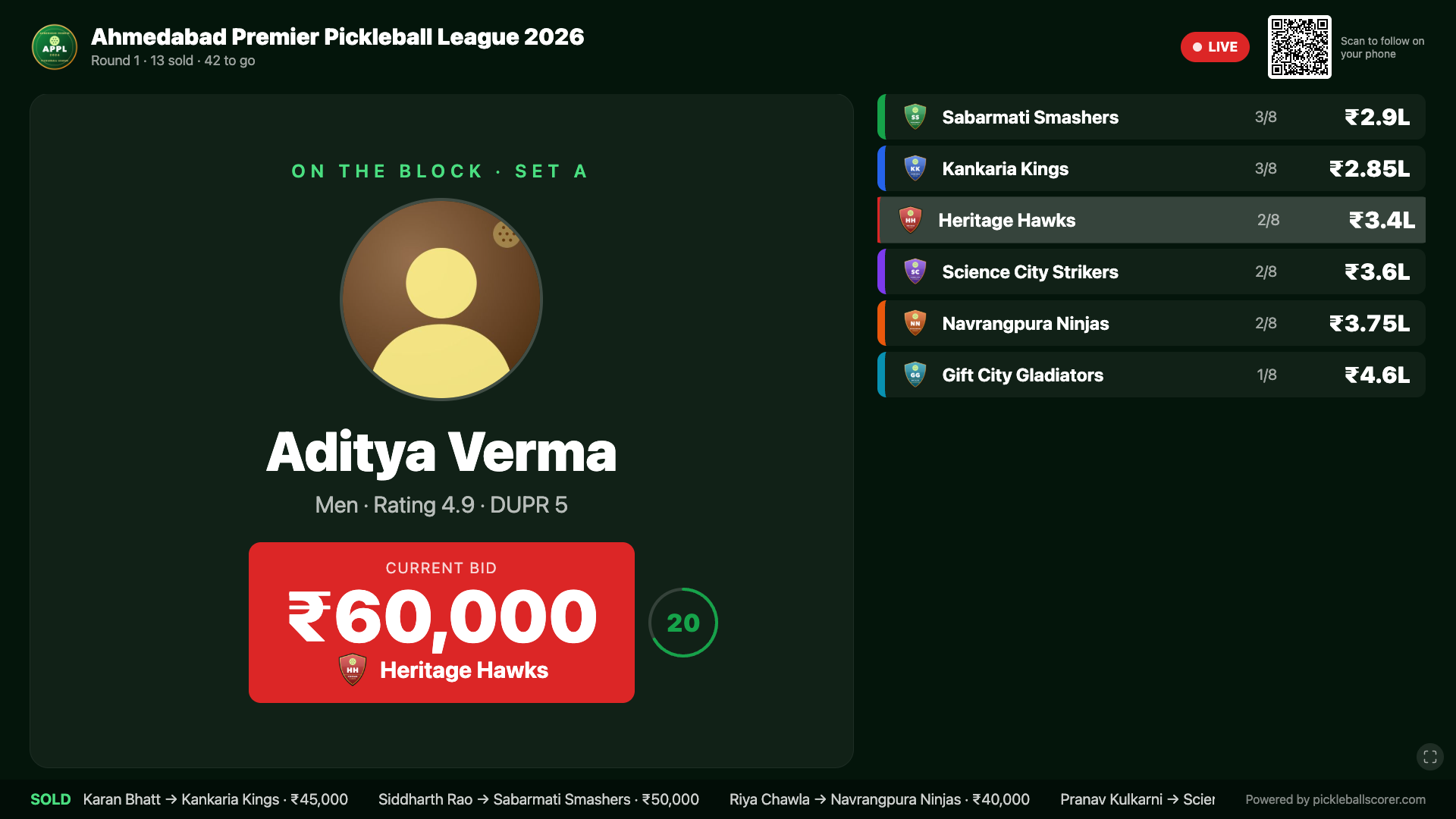
For franchise leagues that build their teams in an auction: a stage screen for the hall, a private page for each team owner, and squad rules checked on every bid. When the last player is sold, the squads go into the league in one step.
Applies to: Team leagues only, and optional. Ladders and Americano sessions take individual entries and have no teams to form.
- 3
Fixtures
The games are made from the players or teams you have. A ladder gets each week's groups, courts and games. A team league gets its round robin of ties and then its playoffs. An Americano or Mexicano is drawn round by round, or loaded from your own schedule.
Applies to: Every format, each in its own way.
- 4
Match day
The Court Desk shows what is on every court and calls the next match, with a notification to the players. Scores come from the app at the court or are typed in on the website. Each court has a link for a court-side screen and for a stream overlay.
Applies to: Every format. Court screens and the overlay show a running score for matches scored point by point in the app. Americano and Mexicano games are entered as final scores.
- 5
Standings, results and player stats
The table is recounted as each result goes in, and again if you correct one. A ladder keeps the season table and a card for every player with their rank week by week, their games, partners and opponents. A team league table shows top players and highlights. An Americano table can be downloaded with every result.
Applies to: Every format. Singles and doubles matches scored in the app also feed each player's match stats and rating.
- 6
The public league page
One link for players, families and sponsors. It opens in any browser with no app and no login, and shows the fixtures, the scores as they come in and the table.
Applies to: Every format. The page goes live when you publish the league.
Which league are you running?
A league is not a long tournament. The format decides who plays whom, how the table works and what you do each session. Start with the one that matches your players.
Weekly ladder league
The same night every week. Players enter on their own, play in groups at their level, and move up or down after each session.
Team league
Franchise, club or corporate teams. Each meeting between two teams is a tie made of several matches, with a league table and playoffs.
Americano or Mexicano
A social session in one day. Partners change every round and every player has their own line in the table.
Round robin league
Fixed pairs or singles. Everyone in the group plays everyone, with a table and an optional playoff.
Not sure yet? Read how to run a pickleball league, which compares the formats.
Groups by rank, new partners every game, up and down each week
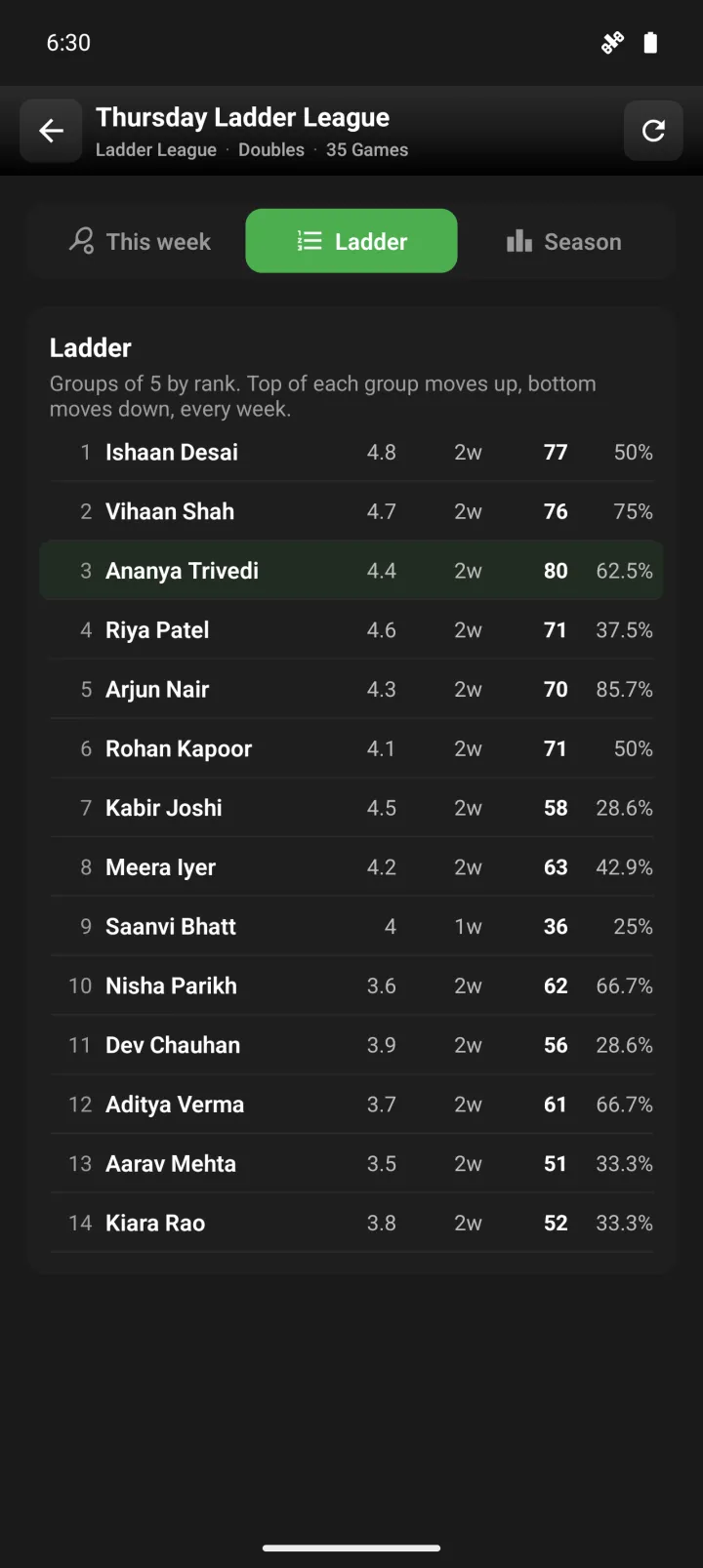
Every player has a place on the ladder. Each week the ladder is cut into groups by rank, usually five players on one court. Partners rotate so everyone partners everyone in the group. At the end of the session the top of each group moves up and the bottom moves down.
What you do as the organizer
- Set the group size, the number of weeks, how many players move up and down, the game length, the tie-break rule and what happens to an absent player.
- Generate the week: tick who is away, and the groups, courts and every game are made for you. When the numbers do not divide evenly, groups of four and six take the leftovers.
- Print one sheet per court with the games in order and boxes for the scores.
- A late withdrawal? Mark the player absent with a substitute's name, or swap in another player for the games still to play.
- Close the week. Groups are ranked, players move, and the points go onto the season table. If a score was wrong, reopen the latest week, fix it and close it again.
- Season already running? Paste your current ladder and past weekly totals and carry on from this week.
What your players get
- One public link, no login: this week's court and games, scores as they come in, the ladder and the season table.
- Find a player by name, sort the season table by total, average or win percentage, and filter by this week's group or by who moved up or down.
- In the app, each player sees which court they are on, with their own group first.
- If you allow it, players score their own games from their phones.
More detail in the guide: how to run a pickleball ladder league.
Teams, ties made of several matches, lineups, a league table and playoffs
Two teams meet in a tie. A tie is a list of matches that you define, for example men's doubles, women's doubles and mixed doubles. Each match has its own points target, side-out or rally scoring, and its own weight in the table. Every team plays every other team, then the top teams go to the playoffs.
What you do as the organizer
- Start from a ready tie format and change any match: a club league with three doubles lines, an MLP-style tie with four doubles and a singles-rotation decider that is played only when the tie is level, or a franchise format with five matches including a whole-team rally.
- Rank the table by ties won or by points, and decide whether a playoff tie is won on points or on matches.
- Set rules per match: men, women or mixed, which player levels may play, a rating cap, how many matches one player may play in a tie, and how many substitutions are allowed.
- Generate the round robin of ties, then seed the playoffs from the league table (1 v 4 and 2 v 3 for four teams).
- Send every team a private link. The captain or owner sets their own lineups and makes substitutions from a phone, without signing in.
- Scoring a match on a phone starts only after its lineup is set, so a whole squad never ends up on one scoresheet by mistake.
What your players get
- A notification on the phone when they are picked in a lineup, and another when their match is called to a court.
- Their own matches listed in the app, with the live score of the tie.
- A public league table with each team's last five results and its current streak, plus top players and highlights such as the biggest win and the closest tie.
- The champions shown on the public page and in the app once the final is played.
Good to know
- Playoffs are a knockout for 2, 4, 8 or 16 teams. There is no third-place tie.
- Teams are set by the organizer. Players do not register themselves into a team league.
Optional: start with a player auction
Build the teams in an auction, then play the league
Franchise leagues often pick their teams in a player auction. You can run that on PickleballScorer too: a stage screen for the hall, a private page for every team owner, and squad rules checked on every bid. When the last player is sold, send the squads into the league in one step. Each team owner becomes a manager of their team and can set its lineups.
Rotating partners, one table of individual players
A doubles session where nobody needs a fixed partner. In an Americano, partners change every round until everyone has partnered everyone. In a Mexicano, each round after the first is paired from the table: in every group of four, first and fourth play second and third, so the games get closer as the session goes on.
What you do as the organizer
- Draw one round at a time, or paste your own schedule from a spreadsheet (round, court, team 1, team 2) and every round is created as you wrote it.
- Numbers that do not divide by four are handled: the extra players sit out a round and the sit-outs are shared around. Each round shows who is sitting out.
- Set a number of rounds, or let an Americano run until everyone has partnered everyone.
- Choose how the table is ranked: total points, win ratio then points, win ratio then point difference, or average points per match.
- Add a final between the top four if you want one. Pick the pairing (first and fourth against second and third, first and second against third and fourth, or first and third against second and fourth) or choose the four players yourself.
- Enter each score as the game finishes and correct one later if needed. The table is counted again every time. Download the results as a spreadsheet at the end.
What your players get
- One public page with every round and the table, no login.
- Find a player by name to see only their games and their line in the table.
- Sort the table by any column: played, won, points scored, points conceded or the difference.
- The same rounds and standings in the app.
Good to know
- The final is a single game. There is no best-of-three final, no semifinal and no third-place match.
- Scores are entered on the website today. In the mobile app, the organizer can enter scores from app version 1.0.105.
- The Americano or Mexicano category is created in the PickleballScorer app, where both are in the format list. After that you can run the rounds from the website or the app.
- The automatic draw puts up to 16 players on court in a round and rotates the rest in. For a bigger field, paste your own schedule: it can have any number of games in a round.
Everyone plays everyone, for fixed pairs or singles
The simplest league. Pairs or single players are placed in a group and everyone in the group plays everyone else. A large entry is split into pools, and the top of each pool can go on to a playoff.
What you do as the organizer
- Add a category, choose round robin, or pool play followed by a playoff, and generate the fixtures.
- Let the pools be split for you, or set the number of pools or the pool size yourself.
- Bring players in from a spreadsheet, or let them register from the public page.
What your players get
- A public page with the fixtures, the scores and the standings of their group.
- Their matches in the app, and a notification when a match is called to a court.
Round robin and pool play are part of Tournament Studio, together with single and double elimination and Swiss. See how tournaments run.
How it runs on the day
Whatever the format, a session comes down to the same things: get the right players onto the right court, get the score in, and show everyone the table.
Score from the court, on a phone
In the app a match is scored point by point, in side-out or rally scoring, or as a final score only. The table updates when the match ends. Americano and Mexicano games are entered as a final score.
Or type the result on the website
Scored on paper, or a phone died? Enter the final score from the organizer dashboard. You can also correct a score, award a walkover or reopen a match.
Court Desk
One screen that shows what is on each court and what is up next. Call a match to a court and the players get a notification that they are up. It works on a phone as well as a laptop.
Court screens and a stream overlay
Every court has its own link. Open it on a TV beside the court, or add it to OBS as an overlay on your stream. It follows whatever match is on that court and shows the live score when the match is scored point by point in the app.
One plan for leagues and tournaments
A league is set up as a tournament in your organizer account, with a ladder, a team league or a round robin as one of its categories. It runs on the same Pro Organizer plan as tournaments: one yearly subscription, with no per-player fees. Players follow and score for free.
Running one-off events as well? See Tournament Studio.
Tell us how your league works.
Send us your format or your current spreadsheet. We will set your league up with you on a call, on your own player list, so you see it working before your first session.
Questions league organizers ask
Anything else? Get in touch.
Which league format should I choose?
If players enter on their own and you play on the same night every week, run a ladder league. If you have teams, with owners or captains, run a team league. If you want a social session that is finished in one day, with no fixed partners, run an Americano or a Mexicano. If you have fixed pairs who all want to play each other, run a round robin.
What is the difference between Americano and Mexicano?
Both are doubles with rotating partners and an individual table. In an Americano the schedule is built so that everyone partners everyone once. In a Mexicano only the first round is drawn up front. After that, each round is paired from the current table, so players near each other in the table play together and against each other.
Can I use my own schedule instead of an automatic draw?
For an Americano or Mexicano, yes. Paste your fixture with one match per line (round, court, team 1, team 2), copied straight from Excel or Google Sheets, and every round is created exactly as written. You can do this until the first match has been played or called to a court.
Is there a final in an Americano?
Only if you want one. You can add a final between the top four of the table and choose how they are paired, or pick the four players yourself. It is a single game. There is no best-of-three final, no semifinal and no third-place match. The result of the final decides the champions and is not counted in the table.
Does one system really cover the whole league?
Yes, with one difference between formats. Registration, fixtures, match day, scoring, the table and the public page are there for every league. Player sign-up applies to ladders, Americano, Mexicano and round robin leagues, while team leagues have their teams added by the organizer or sent from the auction. The player auction is for team leagues only.
Can players pay their entry fee online?
You choose how players register. Either you approve each sign-up and collect fees your own way, recording each payment as it comes in, or players pay online to confirm their place. Online payment is for fees in Indian rupees and needs your payout account to be connected first. Ask us and we will tell you what is available for your league.
Do players need the app?
Not to follow the league. The public page works in any browser. Players need the app to score a match from the court and to get notifications, for example when their match is called.
Do we need a player auction to run a team league?
No. You can add teams and their players yourself. If your league does hold an auction, you can run it on PickleballScorer and send the finished squads into the league in one step.
We are already halfway through a ladder season on a spreadsheet. Can we move?
Yes. Paste your current ladder order and each player's past weekly totals, and the season carries on from this week. Players who do not have an app account yet are added by name and can be linked to their account later.
Can captains set their own lineups?
Yes. Each team has a private link that you send to its captain or owner. From that link they set their own team's lineups and make substitutions on a phone, without signing in. If a link reaches the wrong person you can replace it with a new one.
What does it cost?
A league is set up as a tournament in your organizer account, so it runs on the same Pro Organizer plan as tournaments: one yearly subscription with no per-player fees. Players follow and score for free. Book a demo or message us for the current price, and to talk about a player auction.